Search Pinoy Tech Buzz

Showing posts with label cybercrime. Show all posts

Friday, October 2, 2009

Typhoon "Ondoy" now threatens cyberspace


After devastating several parts of the country, tropical storm "Ondoy" (Ketsana) is now threatening to wreak havoc on cyberspace as well.

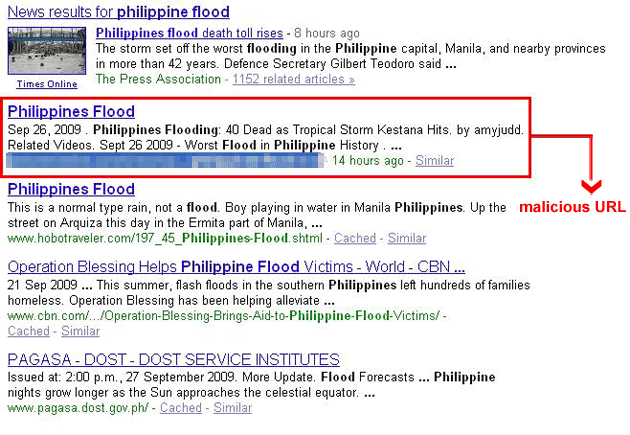
Computer security firm Trend Micro said cyber-criminals are exploiting worldwide attention on "Ondoy" by sending trojan programs disguised as news updates.

“Cybercriminals heartlessly exploited the calamity that unfolded in the Philippines. They rigged multiple URLs related to this news to point unknowing users to FAKEAV. Such SEO poisoning campaigns attract users all over the Web especially those who are trying to get information about their loved ones and fellow countrymen in the Philippines," senior threat analyst Joseph Pacamarra said in Trend Micro's blog site.

Users who click the links in the supposed news sites will be redirected to several landing pages where they are asked to download an EXE file, soft_207.exe.

The file, TROJ_FAKEAV.BND, does GeoIP checks that target specific regions or locations.

But Trend Micro said the new development is that the cyber-criminals use search engine optimization, such that their sites come out on top of search results.

"Although riding on tragic events is not exactly new, what is notable is it employed once again blackhat SEO to lead users to a FAKEAV as we had previously discussed here," Trend Micro said.

It advised users to be wary in clicking any URLs.

Wednesday, August 19, 2009

Internet – Hazardous as a Pandemic?

(Net Precautions part 1)

So much has been said about the Internet and the wealth of information it gives us. In the same token as we’ve written several times on the dangers and ill affects it may have on our kids as well. I can’t stress it enough, I guess, basing it on my own experiences with my Keoni. So, parents, once again, please beware –the Internet can be dangerous to your child’s moral health.

With the advent of the H1NI pandemic in the country, parents were naturally worried about their children catching the dreaded flu as they finally went back to school after an extended summer vacation due to the class suspension.

But aside from this danger in the real world, there is another danger in the virtual world of the Internet that parents should be concerned about – the possibility of their kids being exposed to, and becoming victims of, spam mail, offensive websites, photographs and sexual videos that have been circulating in the Internet such as the controversial ones that have been in the headlines lately.

It seems like more and more kids nowadays are starting to use computers at a younger age than their parents or even their older siblings. They spend much of their time either browsing the Internet, playing online games or updating their profile in social networking sites. Why, my 7-year old Keoni has two email accounts, one in Yahoo and one Gmail, a Friendster, Facebook and ToonTown Account! Thank God I monitor the kinds of social sites he could belong to much less check on the sites he goes to.

Aside from offensive materials, computers can also suffer from other web surfing hazards such as the infection of Trojans and computer viruses. Additionally, the children may be downloading files and programs, unaware that doing so may be a crime against the Intellectual Property (IP) Code of the Philippines, which prohibits any form of copying of copyrighted material without permission from the owner.

“The number of Internet users is growing exponentially every year and the Internet is fast-becoming a staple educational resource. With this boom in technology, Filipino Internet users should be given enough information that will not only allow them to derive full benefit from use of the Internet, but also protect them from the apparent risks present in the cyber world,” said Dr. William Torres, President, Philippine Internet Services Organization (PISO).

Recognizing the enormous influence of the Internet and the need for information on safe Internet usage, the Business Software Alliance (BSA), the foremost organization dedicated to promoting a safe and legal digital world, has been maintaining B4USurf (www.b4usurf.org) an online resource website that teaches cyber-ethics and cyber safety to teachers, parents and children.

If not properly guided, what looks like an innocent playground can turn into a danger zone for our kids. The net is also populated with online hazards and threats. We encourage parents to learn the ways and means of cyber-ethics and cyber-safety with their children by referencing the resources available on the B4USurf website.

Looks like the future generation will continue to be immersed in the digital age which gives us, parents, all the more reasons to be wary. Due to the outpour of requests from parent email senders, one again here is a guide for children in the promotion of safer Internet us. (To be continued)

Tuesday, August 18, 2009

Backroom cyber warriors trawl web for extremist threats

Nur Azlin Mohamed Yasin spends several hours a day trawling the Internet, but she is not your typical young surfer.

The 24-year-old Singaporean research analyst is constantly on the lookout for bomb-making manuals, video clips of Islamist militants in training and fiery extremist chatter that could hint at an imminent attack somewhere.

From her computer, she enters a world where young Muslims openly volunteer to fight against US-led coalition troops in Afghanistan or learn how to make explosives out of everyday materials.

It is a place where Al-Qaeda terror network chief Osama bin Laden is venerated and the three Indonesian men executed for their role in the Bali bombings of 2002 are held up as poster boys for would-be recruits.

"This whole thing is worrying," she told Agence France-Presse in an interview, referring to a growing trend of individuals imbibing radical ideas online.

Nur Azlin is one of five research analysts at the S. Rajaratnam School of International Studies who monitor extremist websites daily to get a sense of an emerging battleground in the fight against terrorism.

All of them happen to be women and their collective skills include knowledge of Arabic, Bahasa Malaysia, Bahasa Indonesia -- and geopolitical issues.

"After you sit down, think about it and do a trend analysis, you say 'Oh my God! this is really happening,'" said Nur Azlin, who works for the school's International Center for Political Violence and Terrorism Research.

"You can see the radicalization process unfold online."

There are an estimated 5,500-6,000 websites worldwide peddling extremist ideas, according to the researchers, who work from a spartan office in a suburban university campus.

Nur Azlin is tasked to monitor and analyze websites in Southeast Asia, a region that hosts notorious organizations such as the Jemaah Islamiyah movement and the Abu Sayyaf group operating in the southern Philippines.

She estimates that there are around 192 extremist websites in the region, many of them individual blogs which have mushroomed since early 2008 when Internet blogging became popular.

Singapore, a staunch US ally and international finance center, considers itself a prime target for terrorist attacks like last month's deadly hotel bombings in Jakarta aimed at symbols of Western influence.

Home Affairs Minister Wong Kan Seng has warned that "self-radicalised" individuals have emerged as a new security threat.

In 2007, Singapore announced the arrest of five suspected Islamic militants, among them local law lecturer Abdul Basheer Abdul Kader, who allegedly planned to pursue "jihad" in Afghanistan after getting radical ideas from the Internet.

When analyst Nur Azlin started monitoring the websites in early 2007, most of the content was in the form of articles urging Muslims to fight back against perceived oppression, she recalled.

They were usually accompanied by photos like a child allegedly maimed during an attack by coalition forces in Afghanistan or by Israeli troops in Palestine.

In late 2007, computer hacking manuals started to appear on Southeast Asian websites, uploaded by individuals in online forums, she said.

Forum participants, some of whom identified themselves as undergraduate students from Indonesia and Malaysia, urged each other to hack websites they considered to be promoting liberal Muslim views.

"By early 2008, we started to see bomb-making manuals and bomb-making videos," Nur Azlin recalled.

With the appearance of these manuals -- taken from Arabic websites -- the reaction from forum participants got more virulent, as they goaded each other to take action rather than stay passive supporters or sympathizers, she said.

In one of the exchanges, participants tried to organize arms training but some said they did not have money to buy AK-47 assault rifles, Nur Azlin said.

A group called "Indonesian Airsoft Mujahideen" stepped in and offered to facilitate their training using air rifles and paintball machines, which are widely used for play sessions at corporate training seminars in Asia.

"They would rent the place much like a team-building activity," Nur Azlin said. "They used this training in the meantime that they don't have their AK-47s."

Jolene Jerard, 26, a manager at the center, said the analysts compile a monthly report about their findings.

The extremist videos they download -- now in high definition and professionally taken compared with the grainy amateurish clips of the past -- are put into a database, one of the biggest collections in Southeast Asia.

The center shares its findings and analyses with the relevant government authorities and foreign diplomats visit the school for briefings.

"The cyberdomain is an area where governments have been gradually moving into," Jerard said.

"It's a changing threat landscape. I think it is increasingly becoming important and governments are definitely enthusiastic about countering it and putting enough resources in place."
Tuesday, August 4, 2009

Kaspersky To Hold Student Summit On Cybercrime


Kaspersky Lab announces that it is holding its international student conference dubbed, “IT Security for the Next Generation’’ as part of the Kaspersky Academy education program.

This conference brings together students, experts, scientists and researchers from around the world in a collaborative environment to present and discuss issues relating to cybercrime. It provides a platform for the next generation to be able to share their respective knowledge and experiences and to develop new ideas to improve the level of security in information technology.

To encourage an outstanding number of participants in the program, Kaspersky Lab has recently introduced the South East Asian (S.E.A.) Cup for this conference in addition to existing regional cups, such as the Russian and CIS Cup, European Cup.

The introduction of the S.E.A. Cup is expected to draw an overwhelming participation interest from many countries in the region including the Philippines, Malaysia, Singapore, Thailand, Vietnam, Indonesia and others.

Bachelor students from universities, institutes of higher education and graduate schools in the Philippines are welcome to apply. Participation in the program can either be as individual or as a group. Interested parties are required to register online via http://www.kaspersky.com.sg/it_security_conference_about.htm before 15 August 2009 to qualify their participation.

Program committees including Kaspersky Lab CEO Eugene Kaspersky will evaluate the submissions of which three best research papers from the Philippines, will receive US$1,000 each and automatically qualify for the next round to compete with other fellow Asians at the S.E.A. Cup where the top three research papers would receive US$1,500 and move on to the next level, representing South East Asia in the International Cup.

The final three best research papers will be announced on November 15, 2009, to represent the S.E.A. Cup during the International Conference for the winners from all over the world in April 2010 whereby all the expenses will be paid for. Place and exact date are to be settled.

“Professional scientific communities are especially relevant today and the company deems its duty to actively participate in the development of science and bring together talented young scientists from different countries,” says Suk Ling Gun, Managing Director of Kaspersky Lab in Southeast Asia. “We hope that the “IT Security for the Next Generation’’ conference will provide an opportunity for young specialists from all over the world to develop and exchange their ideas.”

Those wishing to participate should prepare and send their research papers on one of the following topics to the organizing committee by September 15th, 2009:
  • Future ICT-related problems
  • Psychology of cybercrime
  • Economic structure of cybercrime
  • Online commerce of e-crime
  • Law and security: e.g. intellectual property (rights & innovation, rights transfer)
  • Impact, threats, incidents caused by botnets
  • Measuring malware & spam
For further information, please send an email to studconf@kaspersky-sea.com.